Get Your Written Food Safety Procedures Inspection-Ready Without Paying a Consultant
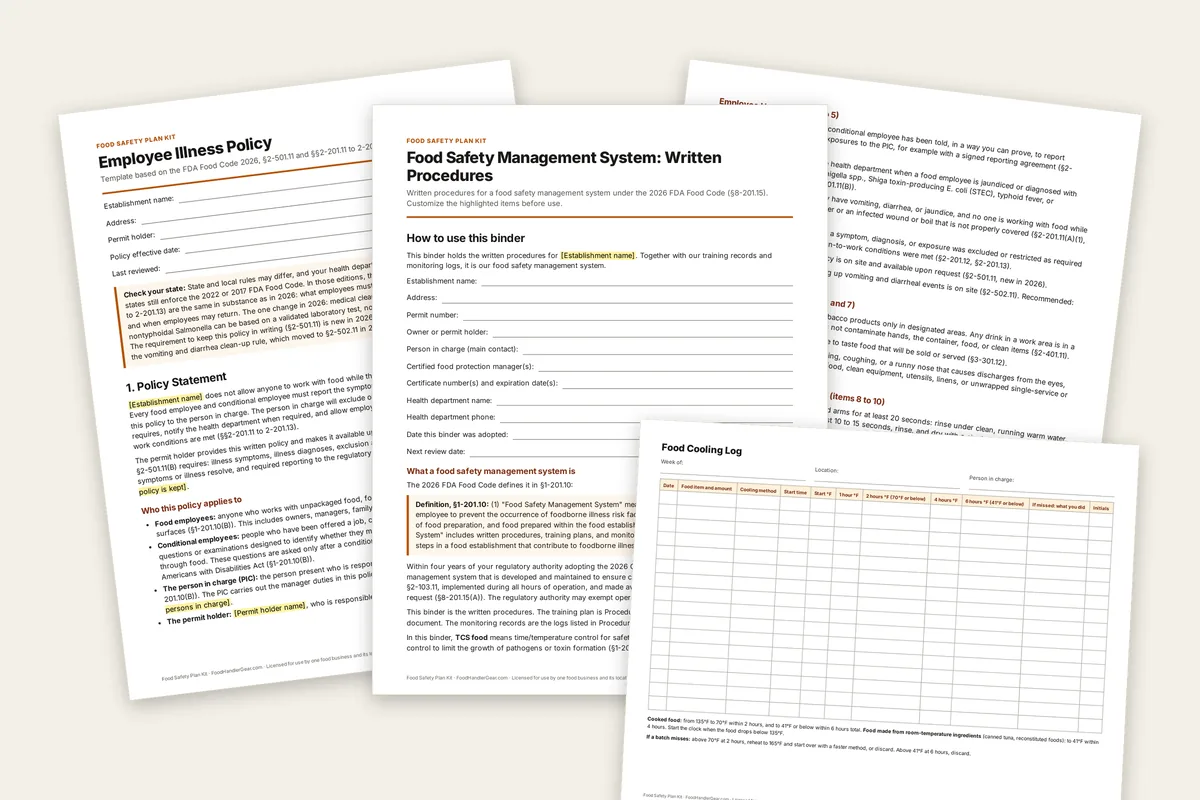
Get your written food safety procedures inspection-ready without hiring a consultant to write them. The Food Safety Plan Kit is the written procedures, employee illness policy, vomit and diarrhea clean-up procedure, training records, and logs that a small food business fills in itself. Every rule is in plain English, with the 2026 FDA Food Code section behind it. An inspection result depends on the kitchen that day, not on owning these files.
Once a health department adopts the 2026 code, it asks for a written food safety management system: written procedures, training plans, and monitoring records (§8-201.15, defined in §1-201.10). The kit includes those written procedures, training records, and monitoring logs. Many plan reviews for a new, converted, or remodeled establishment ask for evidence that a system is developed or being developed (§8-201.12(E)). What a plan review requires varies by health department, and the kit does not cover the rest of that permit process, such as equipment lists or floor plans. A written employee illness policy (§2-501.11) and a written procedure for cleaning up vomiting and diarrhea (§2-502.11) are required in the 2026 code too. Most places still enforce the 2022 code or an older one. The temperatures and times in the kit match both editions. Your local rules still win. See which Food Code edition your state uses.
8 Inspection Topics the Kit's Documents Cover
Each reason is an inspection topic the kit's files actually cover. Item numbers are from FDA's model Food Establishment Inspection Report, Form 3-A, in Annex 7 of the 2026 Food Code. Section numbers are the ones written into the templates. Your health department may use its own form. Its rules come first.
1. The person in charge can show a written system
Form 3-A starts with supervision (items 1 and 2). A person in charge is present during all hours (§2-101.11), is a certified food protection manager (§2-102.12), and keeps food safety procedures in use (§2-103.11). The 2026 code calls that active managerial control, and it asks the permit holder for a written system the inspector can see (§8-201.15). Procedure 1 is that duty. The rest of the binder is what the person in charge keeps in use. Food defense, new in 2026, is Procedure 20: staff report tampering to the person in charge (§2-103.11(R)).
2. Employee illness is a policy you can hand over
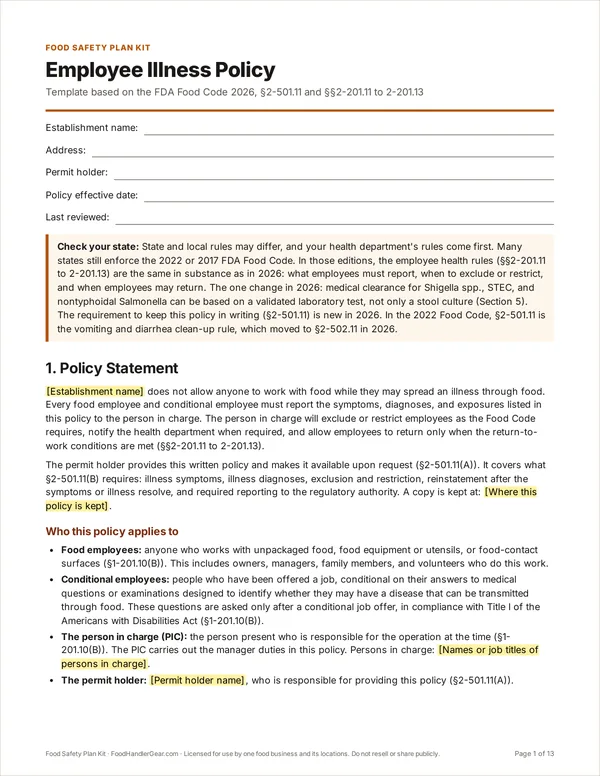
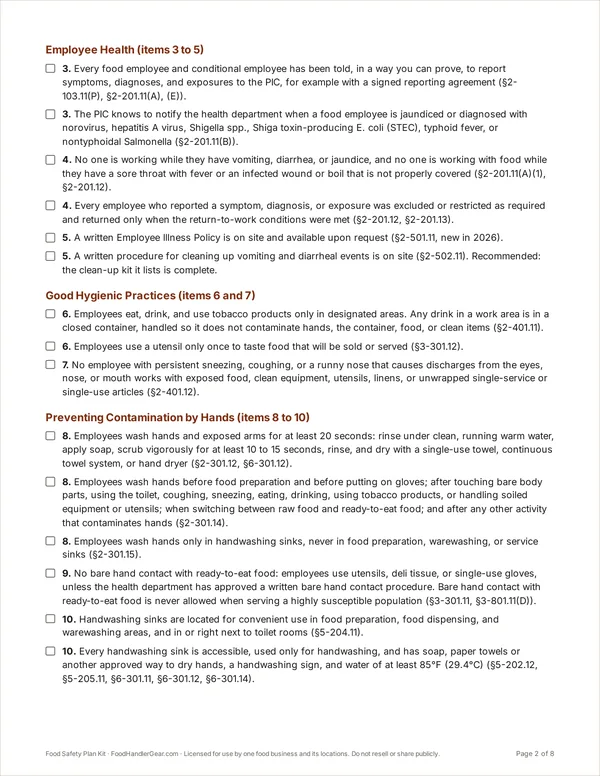
Form 3-A items 3 to 5 are employee health. Food employees report symptoms, diagnoses, and exposures (§2-201.11). The person in charge excludes or restricts them, brings them back only when the code allows (§2-201.12, §2-201.13), and calls the health department when required. The 2026 code adds a written illness policy available on request (§2-501.11). The kit's policy includes the reporting agreement employees sign and an illness report form, plus FDA's Forms 1-A, 1-B, and 1-C from Annex 7: the interview, the reporting agreement, and the medical referral.
3. The vomit and diarrhea clean-up procedure is on site
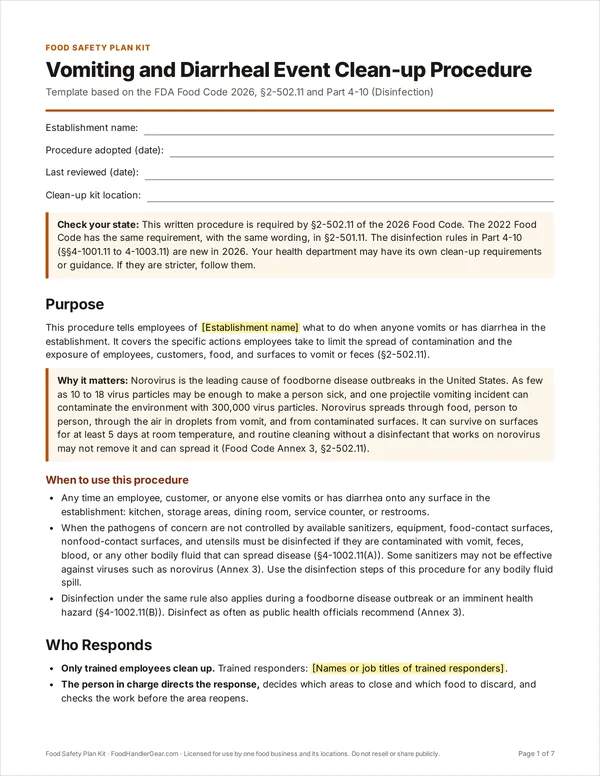
Item 5 also asks for a written procedure for vomiting and diarrheal events (§2-502.11). The 2022 code puts the same requirement at §2-501.11. The kit's clean-up document has the steps, a clean-up kit checklist, and an incident record. Disinfection after vomit, diarrhea, blood, or an outbreak is Procedure 17, covering Part 4-10 (§§4-1001.11 to 4-1003.11). Those disinfection rules are new in 2026, so they apply when your health department adopts that edition.
4. Handwashing and bare-hand contact are written down
Items 8 and 9 are contamination from hands. Procedure 3 is when to wash (§2-301.14) and how, for at least 20 seconds at a handwashing sink (§2-301.12). Procedure 4 is no bare-hand contact with ready-to-eat food: utensils, deli tissue, or single-use gloves, unless the health department has approved a written bare-hand procedure (§3-301.11).
5. Receiving has a procedure and a log
Items 11 to 14 are approved source. Food comes from a source that complies with law, and food from a private home is not used in a food establishment (§3-201.11). Refrigerated time/temperature control for safety (TCS) food is received at 41°F or below, and hot TCS food at 135°F or above (§3-202.11). Shellfish tags are kept 90 days (§3-203.12). Procedure 5 is the receiving steps. The Food Receiving Log is where the temperature and the accept-or-reject decision are written.
6. Cooking, cooling, holding, and date marking have limits and logs
Items 18 to 24 are time and temperature. The kit has a procedure for each limit, and a log where the check is recorded:
- Cold holding at 41°F or below (§3-501.16), Procedure 6, and the refrigerator and freezer log.
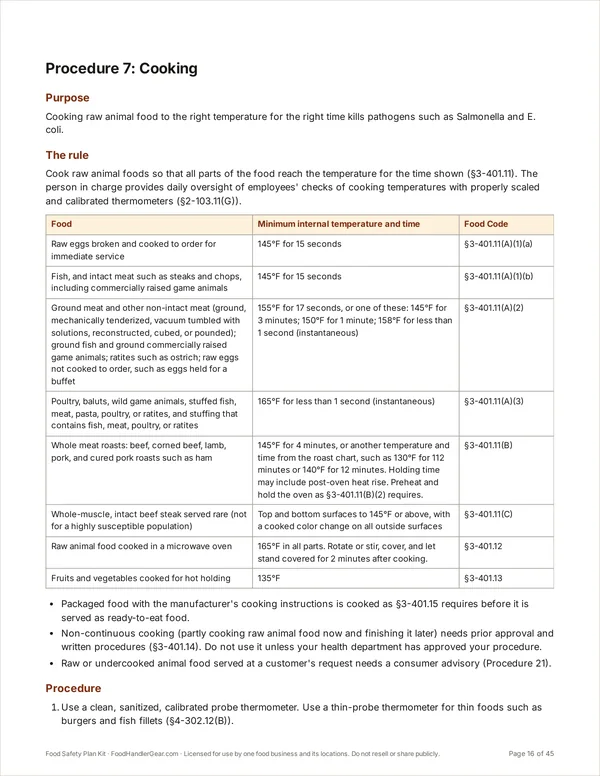
- Cooking to the temperature for that food (§3-401.11), Procedure 7.
- Hot holding at 135°F or above (§3-501.16), Procedure 8, and the hot and cold holding log.
- Cooling from 135°F to 70°F within 2 hours and to 41°F within 6 hours total (§3-501.14), Procedure 9, and the cooling log.
- Reheating for hot holding to 165°F for 15 seconds within 2 hours (§3-403.11), Procedure 10.
- Thawing only by a method in §3-501.13, Procedure 11.
- Date marking ready-to-eat TCS food held more than 24 hours, and discarding it within 7 days (§3-501.17), Procedure 12.
- Time as a public health control, only if you use it, with the written procedure on site (§3-501.19), Procedure 13.
Those temperatures are only as good as the thermometer. Procedure 18 covers thermometers accurate to ±2°F and calibration to the manufacturer's instructions (§4-302.12, §4-203.11, §4-502.11), with the Thermometer Calibration Log.
7. Contamination, allergens, sanitizer, and chemicals are in the binder
Items 15 to 17 are protection from contamination. Items 27 and 28 are toxic substances. Procedure 14 keeps raw animal food separate from ready-to-eat food (§3-302.11). Procedure 16 is clean first, then sanitize, at the concentration on the label and in §4-501.114, checked with a test kit. The Cleaning and Sanitizer Log records the strength and the water temperature. Procedure 19 is labeled chemicals stored so they cannot contaminate food (§7-102.11, §7-201.11). Procedure 15 is allergen awareness: the nine major food allergens in §1-201.10 (milk, eggs, fish, crustacean shellfish, tree nuts, wheat, peanuts, soybeans, and sesame) and staff who can answer an allergy question (§2-103.11(O)). If you serve raw or undercooked animal food, Procedure 21 is the consumer advisory on item 25 (§3-603.11). Delete it if you serve none.
8. You can walk the inspection report before the inspector does
The self-inspection checklist follows Form 3-A from item 1 through item 56: risk factors and public health interventions first, then good retail practices. Check a box only when the answer is yes, write N/A when a line does not apply, and list what you fix. Procedure 23 names the monitoring logs. Procedure 24, the Corrective Action Log, and the Weekly Manager Review are where an out-of-range reading gets a written fix and a manager's weekly sign-off. Training is Procedure 22, with three forms: a new-hire orientation checklist, a training sign-off sheet, and a food handler and manager certificate tracker.
Every Template and Log in the Kit
The download is one ZIP. Each file you customize is a Word document (.docx) that opens in Microsoft Word, Google Docs, Apple Pages, and LibreOffice, and a PDF ready to print. Anything you must fill in, such as your business name, your sanitizer, and your health department's phone number, is highlighted in yellow. FDA Forms 1-A, 1-B, and 1-C are FDA's own forms, included as a PDF copied from Annex 7. The Start Here guide tells you to delete procedures that do not match what you actually do.
24 written procedures
These are the sections of 01 Food Safety Plan: Written Procedures. Each one has the rule, the steps, monitoring, corrective actions, verification, and the record that goes with it.
| Procedure | What it's for |
|---|---|
| 1. Person in charge and active managerial control | Who is in charge on every shift, and how that person keeps the procedures in use (§2-101.11, §2-103.11). |
| 2. Employee health | A short version of the illness rules. The full policy, agreement, and report form are in the separate illness document. |
| 3. Handwashing | When and how employees wash hands (§2-301.12, §2-301.14). |
| 4. No bare-hand contact with ready-to-eat food | Utensils, deli tissue, or gloves for food that will not be cooked again (§3-301.11). |
| 5. Receiving and approved sources | Checking deliveries for source, temperature, and damaged packages (§3-201.11, §3-202.11). |
| 6. Cold holding and refrigeration | Keeping TCS food at 41°F or below, and frozen food frozen (§3-501.16). |
| 7. Cooking | Cooking temperatures and times for raw animal foods (§3-401.11). |
| 8. Hot holding | Holding hot TCS food at 135°F or above (§3-501.16). |
| 9. Cooling | The 2-hour and 6-hour cooling limits (§3-501.14). |
| 10. Reheating for hot holding | Reheating cooked, cooled food to 165°F for 15 seconds within 2 hours (§3-403.11). |
| 11. Thawing | Thawing in the refrigerator, under running water, or as part of cooking (§3-501.13). |
| 12. Date marking and discarding | Marking ready-to-eat TCS food held more than 24 hours, and the 7-day discard date (§3-501.17). |
| 13. Time as a public health control (optional) | Holding food without temperature control for a marked time. Delete it if you do not do this (§3-501.19). |
| 14. Preventing cross-contamination and safe storage | Separating raw animal food from ready-to-eat food in storage and prep (§3-302.11). |
| 15. Food allergen awareness | The nine major food allergens and how staff answer an allergy question (§1-201.10, §2-103.11(O)). |
| 16. Cleaning and sanitizing | Wash, rinse, sanitize, and check sanitizer strength with a test kit (§4-602.11, §4-501.114). |
| 17. Disinfection after vomiting, diarrhea, blood, or an outbreak | When a sanitizer is not enough and a disinfectant is required (Part 4-10, new in 2026). |
| 18. Thermometers and calibration | Thermometers that are on hand, accurate to ±2°F, and calibrated (§4-302.12, §4-502.11). |
| 19. Chemicals | Labeled cleaners, sanitizers, and disinfectants stored away from food (§7-102.11, §7-201.11). |
| 20. Food defense | Watching for tampering and reporting it to the person in charge (§2-103.11(R), new in 2026). |
| 21. Consumer advisory (if serving raw or undercooked animal foods) | The menu disclosure and reminder for raw or undercooked animal food (§3-603.11). Delete it if you serve none. |
| 22. Training plan | Which procedures staff learn, and where the training is recorded (§1-201.10). |
| 23. Monitoring records | Which logs prove the checks happened (§1-201.10). |
| 24. Corrective actions and weekly verification | What to do when a check is out of range, and the manager's weekly review of the logs. |
Employee illness policy and FDA forms
| Document | What it's for |
|---|---|
| 02 Employee Illness Policy | The written policy §2-501.11 asks for: what employees report, when they stay home, when they come back, and when you call the health department (§§2-201.11 to 2-201.13). |
| Employee Reporting Agreement | The sign-off in section 8 of that policy, so you can show employees were told to report illness (§2-103.11(P)). |
| Employee Illness Report | The form in section 9 for one illness report: symptoms or diagnosis, exclusion or restriction, the health department call, and the return-to-work date. |
| FDA Forms 1-A, 1-B, and 1-C | FDA's interview, reporting agreement, and medical referral forms, copied from Annex 7 of the 2026 Food Code. PDF only. |
Clean-up, training, and the self-inspection
| Document | What it's for |
|---|---|
| 03 Vomiting and Diarrheal Event Clean-up Procedure | The written clean-up procedure (§2-502.11), including who responds and the step-by-step clean-up. |
| Clean-up kit checklist | The supply list inside that procedure, so the kit at the marked location is complete. |
| Incident record | The form filled out after every vomiting or diarrheal event: where it happened, what was used, and what food was discarded. |
| New-hire food safety orientation | A first-shift checklist in the Training Records document: illness reporting, handwashing, temperatures, sanitizer, allergens, and where the logs are. |
| Training sign-off sheet | A sheet for later training, with the date, topic, trainer, and employee signature. |
| Food handler and manager certificate tracker | A list of each employee's card or certificate, who issued it, and when it expires. |
| 05 Self-Inspection Checklist | A walk-through in Form 3-A order, items 1 to 56, so you find gaps before an inspection. |
| 00 Start Here | How to customize the files in an afternoon, which procedures to delete, and which Food Code edition applies to you. |
Eight logs
Six of these match the free printable logs on the log templates page. The kit adds editable Word versions, plus the corrective action log and the weekly manager review, which are only in the kit.
| Log | What it's for |
|---|---|
| Refrigerator and Freezer Temperature Log | Air temperature of each cooler and freezer. |
| Hot and Cold Holding Temperature Log | Food temperatures in hot holding and cold holding. |
| Food Cooling Log | Time and temperature as a cooked batch cools. |
| Food Receiving Log | Temperature and condition of each delivery, and a note that shellfish tags were filed. |
| Cleaning and Sanitizer Log | Sanitizer strength and water temperature at the sink, buckets, or dish machine. |
| Thermometer Calibration Log | The date, the reading, and initials each time a thermometer is checked. |
| Corrective Action Log | Every out-of-range check: what was found, what you did, and what happened next. |
| Weekly Manager Review | The manager's weekly pass over the logs, date marks, illness reports, and training sign-offs, with a signature line. |
Look Inside
Built for Small and Independent Operators
The Start Here guide describes the kit as the documents for a restaurant, cafe, food truck, or other food business. It is written for the owner who is also the person in charge: yellow fields to fill in, procedures to delete, and a binder to print. A corporate compliance manual assumes a food safety department and a chain of locations with the same menu. This kit assumes one operation and the menu you actually serve.
Food trucks
The kit names food trucks in the setup guide. The same risk factors apply in a smaller space: a person in charge, handwashing, cooking and holding temperatures, receiving, and an illness policy employees have signed. Print the logs and keep the binder where you can show it. Your mobile-unit permit can add local rules the Food Code does not. Follow those.
Home and cottage kitchens
The Food Code this kit follows says a food establishment may not use food prepared in a private home (§3-201.11). Cottage food laws and some home-kitchen permits are state or local exceptions, and they are not the same from state to state. If your health department licenses the home kitchen and asks for written procedures, an illness policy, or temperature logs, these are those documents: delete or rewrite any line your permit contradicts, including the private-home line if home production is what your permit allows. If your cottage rules exempt you from the food code, you may not need the kit. Ask your health department before you rely on it.
A restaurant that just failed an inspection
The self-inspection checklist uses the same Form 3-A item numbers an inspector using FDA's model report marks, so you can match a cited item to a procedure in the binder and retrain from that page. The Corrective Action Log is where you write what was wrong and what you did. The kit does not change a score already on an inspection report. Your next inspection is still under your local code.
Ghost kitchens
A delivery-only kitchen that holds a food establishment permit is inspected on the same risk factors: cooking, cooling, holding, date marking, allergens, receiving, and employee health. The kit is those written procedures and logs. It does not include a variance or a HACCP plan for a special process such as reduced oxygen packaging, curing, or smoking food for preservation (§3-502.11, §8-201.13). If you run from a home that is not a permitted food establishment, read the cottage section above before you buy.
Get the Kit for $29
Hiring a consultant to write this paperwork is the other way a small kitchen gets it done. This kit is those templates, ready for one operation to customize, as a one-time $29 download. You get the link on screen and by email as soon as checkout finishes. Open 00 Start Here, fill in the yellow fields, delete what you do not do, and print.
The license covers one food business and all of its locations. Updates, when we revise the files, stay on your Lemon Squeezy order page. There is a 30-day money-back guarantee: email tinylaunchpadlab@gmail.com within 30 days of purchase for a full refund.
Done-for-you templates
Food Safety Plan Kit
- Written food safety procedures for every risk factor, ready to customize
- Employee illness policy and clean-up procedure for the 2026 Food Code
- Training records, a self-inspection checklist, and 8 editable logs
What It Isn't
- It is not a promise that you will pass. No template can decide an inspection. The kit is the written documents for the topics above. The inspector enforces your local code.
- It does not complete a plan review. It includes the written procedures many plan reviews ask for. Equipment lists, floor plans, and other local submittals stay with your health department, and those requirements vary.
- It is not legal advice, and it does not replace your health department. Where local rules are stricter, or use different section numbers, follow those and cite them.
- It is not written for highly susceptible populations. The procedures say so: hospitals, nursing homes, and child or adult day care follow stricter rules, including Part 3-8. The self-inspection checklist has a line for item 26 and tells you to mark N/A if you do not serve that population.
- It is not a HACCP plan for special processes such as reduced oxygen packaging, curing, or smoking for preservation, which need health department approval (§3-502.11, §8-201.13).
- The basic logs are still free. The six printable log templates stay free, with no signup. The kit adds Word versions, the two extra logs, and the procedures and policies.
Want the one-page version of the approach first? The free food safety plan template shows the steps, limits, and corrective actions these procedures expand on.
How It Works
- Buy the kit through checkout. You get the download link right away, on screen and by email.
- Unzip the download and open 00 Start Here.
- Fill in the highlighted details, delete what does not apply, print, and put it in a binder.
Frequently Asked Questions
Does buying the kit mean I will pass my inspection?
No. The kit gives you the written procedures, illness policy, clean-up procedure, training records, and logs that match the topics on FDA's model inspection report. Your inspector enforces your local food code, which can be stricter or numbered differently. A pass depends on what the kitchen does on the day of the inspection, not on owning the files.
Does my state require a written food safety plan?
The 2026 Food Code requires a written employee illness policy and, within four years of adoption, a written food safety management system. Whether those apply to you depends on when your state or county adopts the 2026 code. Many local health departments already ask for written procedures and logs. Check with yours.
Is the kit based on the 2026 or the 2022 Food Code?
The 2026 Food Code, with notes where it differs from 2022. The temperatures, times, and sanitizer concentrations are the same in both editions, so the procedures work wherever the 2022 code is still in force.
What file formats are included?
Word (.docx) files you can edit in Microsoft Word, Google Docs, Apple Pages, or LibreOffice, and PDFs ready to print. FDA Forms 1-A, 1-B, and 1-C are PDF only. They come in one ZIP download.
Can I use it for more than one location?
Yes. The license covers one food business and all of its locations. Please don't resell it or post the files publicly.
Do I get updates?
When we update the kit, for example as states adopt the 2026 Food Code, the new files are yours at no extra charge. Download them any time from your Lemon Squeezy order page (My Orders), using the email address you bought with.
What if it isn't right for my business?
You're covered by a 30-day money-back guarantee. Email tinylaunchpadlab@gmail.com within 30 days of your purchase and we'll refund you in full, no questions asked.
Who handles the payment?
Lemon Squeezy, an online store platform, runs the checkout, takes the payment, and charges any sales tax. Your card details go to them, not to us, and your receipt and download link come from them.
I have a question before I buy. Who do I ask?
Email tinylaunchpadlab@gmail.com and we'll answer.
Sources
- U.S. Food and Drug Administration, Food Code 2026: §2-102.11, §2-102.12, §2-103.11, §§2-201.11 to 2-201.13, §2-301.12, §2-301.14, §2-501.11, §2-502.11, §3-201.11, §3-301.11, §3-302.11, §3-401.11, §3-403.11, §3-501.13, §3-501.14, §3-501.16, §3-501.17, §3-501.19, §3-603.11, Part 4-10, §4-501.114, §4-502.11, §7-102.11, §7-201.11, §8-201.12, §8-201.13, §8-201.15, and Annex 7 (Form 3-A and Forms 1-A, 1-B, 1-C) — fda.gov.
- U.S. Food and Drug Administration, Summary of Changes in the 2026 FDA Food Code — fda.gov.
The kit is $29
One-time payment, instant Word and PDF download, 30-day money-back guarantee.